

Kosmos Institute
This is impressive… Here is the new announcement from them

Happy First Birthday to Kosmos Institute
A year ago today, we shared the exciting news of our inaugural year of academic programming with a circle of approximately 333 family, friends, and colleagues.
Since that moment, we've been fortunate to collaborate closely with our extraordinary (and growing) team of professors, delivering a variety of courses to nearly 200 students. The outpouring of warm, encouraging feedback we've received has been both humbling and inspiring. Many of our students have returned for multiple courses—an affirmation that our offerings resonate deeply with their time and investment.
After months of dedicated and joyful effort, we are delighted to unveil our second-year offerings, which have been thoughtfully enhanced and enriched. Thanks to the creative brilliance and collaborative spirit of our exceptional professors, along with the invaluable contributions of our new leadership team, Kosmos Institute 2.0 has blossomed into a vibrant, flourishing new chapter.
We warmly invite you to explore our website and discover the exciting new courses and curricula we've designed with your learning journey in mind.
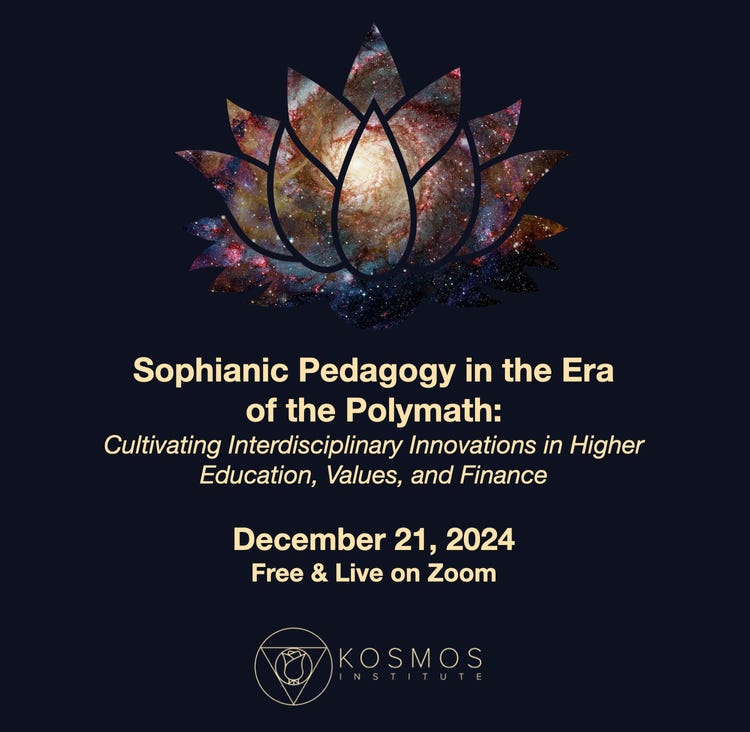
Please join us for a free online conference on December 21, 2025, starting at 8:30 AM PT to help us celebrate one year of Kosmos Institute and learn more about our work and mission.
January Courses Now Enrolling
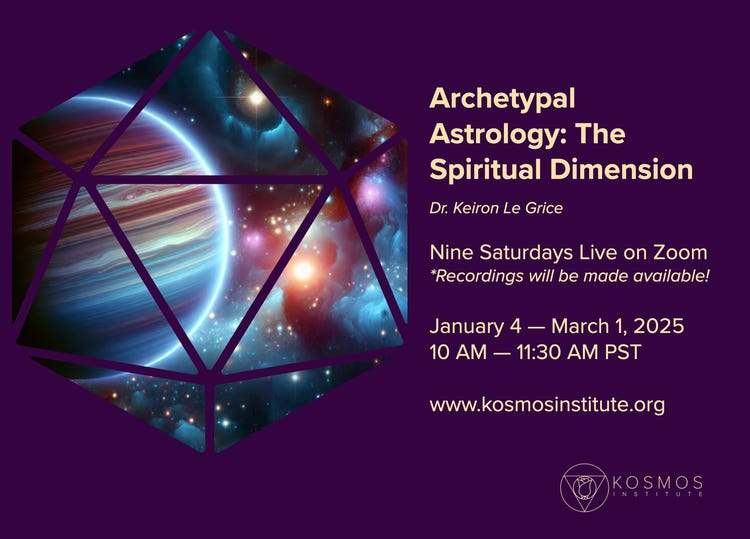
Navigating a spiritually informed way through life in the modern secular age can be bewilderingly confusing. Archetypal astrology offers a pluralistic perspective and cosmological framework to help us map and better understand the varieties of religious experience that we might encounter—such as epiphanies and spiritual awakenings, Dionysian intoxication and Devil possession, existential estrangement and disillusionment, synchronicities and paranormal phenomena, and underworld labors and alchemical transformations. Through an exploration of a range of archetypal themes, as manifest in the lives and work of prominent individuals, this course shows how we can use astrology as a form of orientation and guidance for our own spiritual paths, and as aid to the process of realization that C. G. Jung called individuation.
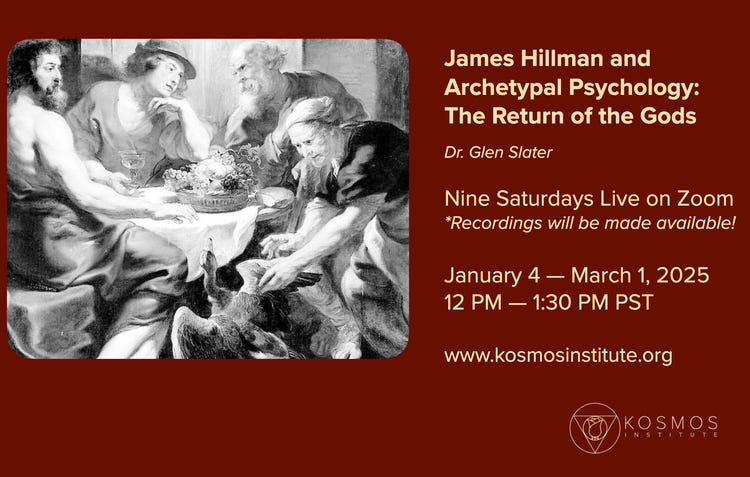
This course is an introduction to Hillman's work. It begins by examining the roots of his approach and engaging critical distinctions he makes between different styles of knowing that play a dominant role in psychology—old and new, spiritual and soulful, and monotheistic and polytheistic. We will then move to focus on the process he calls "soul-making," which he understands to be the opus of psychological life. Hillman argues we make soul by cultivating images, which brings depth, eros, and divine play to the events and circumstances of life. He sets out these notions and other essential elements of his approach in his pivotal book, Re-Visioning Psychology, which will anchor the course. In the final weeks we will apply his perspective to two pressing concerns of our day: our immersion in digital technology and our capitulation to large, abstract systems.
Spring 2025 Courses Now Enrolling
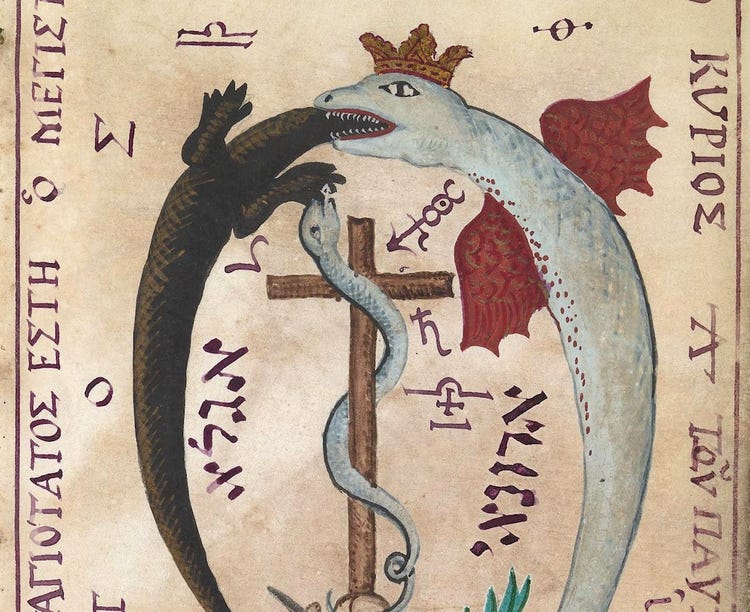
Gnosis I: The White Serpent
Dr. Hereward Tilton
"Know thyself!” – down through the millennia, seekers East and West have striven to free themselves from the dominion of the shadow and attain ‘gnosis’, an experiential knowledge of our innermost identity with the primordial mind. As in Eastern tantra, the Western gnostic traditions associate the liberating ascent of the cosmic axis with idiosyncratic serpentine figures. This course will introduce students to these traditions via the ambiguous serpent symbolism which lies at their heart.
Our quest to uncover the origins and significance of this symbolism will take us to the floodplains of ancient Mesopotamia, where the serpent of primeval chaos contends with the storm god and his thunderbolt weapon, and to ancient Egypt, where the encircling Mehen serpent aids Ra in his nocturnal battle with Apep. The archetypal aspects of this Chaoskampf (‘struggle with chaos’) symbolism are the key to understanding its integration with Platonic psychology among the ancient Gnostics, who cultivated a serpent power rising along the human neuraxis between the genitalia and the brain.
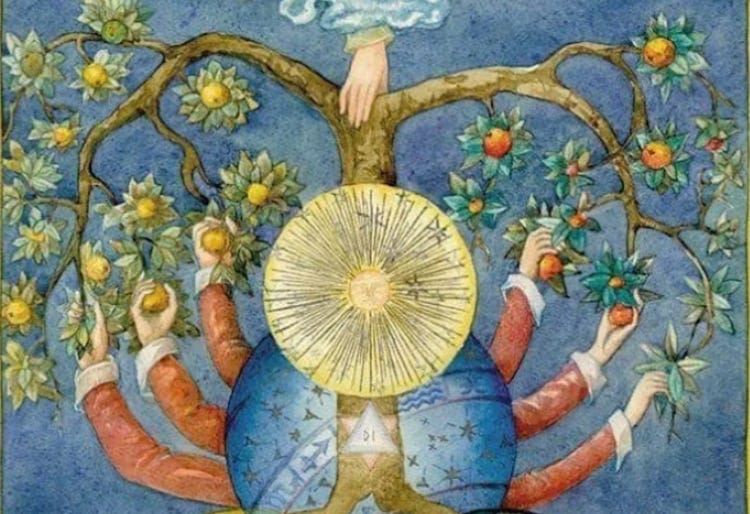
Neoplatonism: The Spiritual Tradition of the West
Dr. Gregory Shaw
Historically, Neoplatonism begins in the 3rd century C.E. with the teachings of Plotinus, in Rome. But "neo" is a term he would not have recognized. Like all Platonists from the 3rd to the 6th centuries, Plotinus understood his teachings to be those of Plato and Pythagoras who, he believed, were passing on the mysteries of the Ancients. After finding a spiritual master who opened him to the "inner source," Plotinus held seminars and taught his students by answering their questions. His answers were collected and edited by Porphyry under the title of Enneads ("groups of nine"), and they reflect the sources that shaped Plotinus' thinking and reveal his uniquely spiritual reading of Plato, Aristotle and other philosophers.
While Plotinus is considered the father of Neoplatonism, the later Neoplatonists were influenced as much by the teachings of the 4th-century Syrian named lamblichus who once studied with Porphyry. He followed Plotinus' Platonism but disagreed with his view that the perfection of the soul requires that it become disembodied. Iamblichus introduced a system of ritual practices to complement the intellectual disciplines of Plotinus. These rituals, called theurgy by lamblichus, aimed at effecting an embodied spirituality. lamblichean Neoplatonism was later absorbed into Christianity and Islam, and the 6th century Neoplatonist, Dionysius the Aeropagite, organized the hierarchy of the Church and the sacraments following lamblichus' theories.
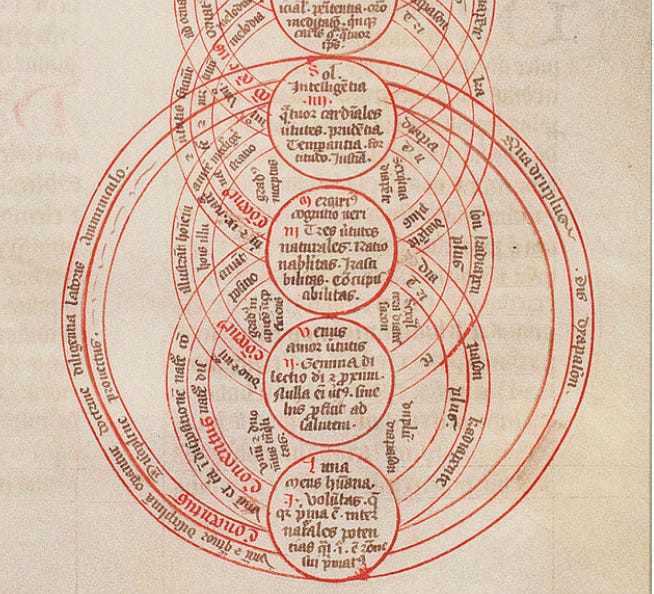
Harmony of the Spheres: Music in the Pythagorean-Platonic Tradition
Dr. Sebastian F. Moro Tornese
This course examines ancient conceptions of music (mousikê) and the philosophical vision of musica contemplativa as a profound expression of cosmic harmony, tracing its development from Orphic and Pythagorean cosmogonies through Plato's Timaeus and culminating in the Neoplatonic synthesis of Plotinus, Porphyry, lamblichus, and Proclus.
Central to this tradition is the belief that music, as a unifying force (henôsis) present from the origin of the universe, mirrors the metaphysical principles of reality and the cosmic order, embodying the harmony of the World-Soul, the celestial spheres, and the human soul.
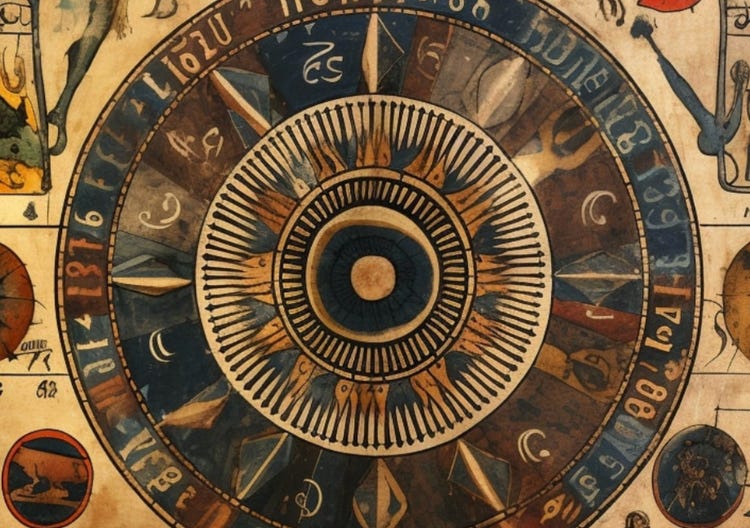
Practical Archetypal Astrology II: Natal Chart Practicum
Dr. Laurence Hillman
Dr. Hillman's focus in these courses is to equip all levels of astrologers with the practical tools needed to understand the meaning and purpose of universal archetypal forces—principles whose active influence in our lives is represented in astrology through the placement, movement, and interaction between the planets, the houses, the sig ins, and the aspects. Dr. Hillman is particularly adept at encouraging students to move past their inherited assumptions and judgments to penetrate further into the rich symbolism of astrological events.
The series is organized into four nine-week courses. Each course builds a strong foundation of practical knowledge upon which the next course will expand. The courses can be taken as a one-year foundational series or as individual courses that assist students in advancing further knowledge in one particular area of focus.
The second course in the series focuses on achieving mastery at casting and reading natal birth charts. Dr. Hillman will gather birth data from enrolled students and each week, a few of these will serve as examples for the whole class. This is a practicum course, meaning that students are encouraged to chime in and learn by doing.
Special Bonus 4-Week Course Enrolling Early for Fall 2025 Quarter

The Soul's Code: Calling & Its Necessary Angels
Dr. Sharon Blackie
In his bestselling book The Soul's Code: In Search of Character and Calling, archetypal psychologist James Hillman declared: 'Each person enters the world called. Each of us, in other words, has a 'calling': we came into the world - to this particular place, at this particular time - for a reason.
Hillman's notion of calling wasn't original: it can be traced at least as far back as Plato, who expressed the idea in his 'Myth of Er'. He suggested that before each of us is born, our soul selects a purpose for us to fulfill during our time on Earth. Hillman took up these ancient ideas, similarly suggesting that before we are born, the soul selects the pattern that it wants to live out. And so we bring into this world, and carry inside us, an innate vision - a kind of concealed invisible potential which we are intended to express during the course of our lives. Although Hillman used many terms for this vision, his preferred way of imagining it was to think of it as an acorn. The acorn, like any seed, carries within it the image of, and the potential to become, the oak tree that it might eventually be - given the circumstances that would allow it to flourish.
In this four-week program, we'll delve deeply into the concept of calling, and work with ways of revealing and remembering what it is that we're here for. To express our calling is to allow ourselves to uniquely express one mode of being, one unique way of embodying what it is to be human, one facet of the creative life force of the universe. How might we uncover the unique gift that we each bring to the world at this time?

Kosmos Institute is a new and stable home for the sacred art of free inquiry. We are an academic locus for the transformation of individual and collective consciousness which occurs through engagement with emergent and ancient knowledge systems within the interdisciplinary precincts of Mythology, Esotericism, Archetypes, and more.

Kosmos Institue
23 Humboldt Street
San Anselmo, CA 94301
USA